RAG vs Fine-Tuning vs AI Agents in 2026: How Businesses Should Choose the Right AI Architecture
Many business AI projects get stuck because teams start with the wrong technical question. They ask, “Should we fine-tune a model?” or “Should we build an AI agent?” before defining what the system actually needs to do.
In 2026, three patterns appear again and again in enterprise AI: retrieval-augmented generation, fine-tuning, and AI agents. They solve different problems. They can also work together.
RAG helps a model use current or private knowledge. Fine-tuning changes how a model behaves based on examples. AI agents add planning, tool use, and multi-step action. Choosing the wrong pattern can increase cost, complexity, and risk without improving the result.
Current cloud guidance reflects this move toward combined systems. Amazon Web Services published guidance in August 2026 for observable enterprise agentic retrieval with Amazon Bedrock Knowledge Bases. AWS also continues to expand model customization and fine-tuning options, including Amazon Nova fine-tuning. The practical lesson is simple: businesses increasingly need an architecture made from the right combination of models, knowledge, and tools.
This guide explains how to choose that combination.
Start With the Business Problem
Before selecting RAG, fine-tuning, or agents, describe the job in one sentence.
Examples:
- Answer employee questions using current HR policies.
- Classify support tickets into 20 categories.
- Create sales proposals in a specific company style.
- Research an account, update the CRM, and prepare a meeting brief.
- Extract structured data from invoices.
- Help engineers troubleshoot products using private manuals.
Each job points toward a different technical pattern.
Ask four questions
- Does the answer depend on current or private knowledge?
- Do we need consistent behavior learned from examples?
- Does the system need to take actions across tools?
- How much risk and operational complexity can we accept?
These questions are more useful than choosing a technology because it is popular.
What Is Retrieval-Augmented Generation?
RAG gives a model relevant information at request time. The system searches an approved knowledge source, retrieves useful passages, and includes them in the model’s context.
The model does not need to memorize the company handbook, product catalog, or customer record. It retrieves the information when needed.
RAG is strongest when knowledge changes
Use RAG for policies, technical documentation, product information, legal guidance, customer records, research libraries, and other information that may change after the model was trained.
A company can update the source document and make the new information available without retraining the base model.
What Is Fine-Tuning?
Fine-tuning trains a model further using examples that represent the behavior you want.
It can improve consistent formatting, classification, tone, terminology, structured extraction, or specialized response patterns.
Fine-tuning is about behavior more than live facts
If your pricing changes every week, do not fine-tune the model each time. Put current pricing in a database or retrieval system.
If the model repeatedly needs to turn a messy support message into the same structured JSON format, fine-tuning may help after you have enough high-quality examples.
What Is an AI Agent?
An AI agent can do more than answer. It can plan a task, choose tools, retrieve information, call APIs, update systems, and continue until it reaches a goal or a stop condition.
An agent might read a support ticket, check account status, search a knowledge base, ask the customer for missing data, create a replacement order, and record the result in a CRM.
Agents add action and orchestration
The model is only one part of an agent. The full system also needs tools, permissions, workflow state, policies, logging, limits, and often human approval.
This makes agents powerful, but also more complex to operate safely.
Quick Decision Table
| Need | Best starting pattern | Why |
|---|---|---|
| Current private knowledge | RAG | Retrieves fresh approved information |
| Consistent format or style | Fine-tuning | Learns repeatable behavior from examples |
| Classification at scale | Fine-tuning or small specialized model | Efficient for stable labeled tasks |
| Multi-step work across systems | AI agent | Can plan and use tools |
| Knowledge plus action | RAG + agent | Uses current information before acting |
| Specialized behavior plus current knowledge | Fine-tuning + RAG | Combines learned behavior with fresh facts |
| Complex workflow with specialized behavior | Fine-tuning + RAG + agent | Use only if simpler architecture is insufficient |
Choose RAG When Accuracy Depends on Current Knowledge
RAG is often the best first step for enterprise assistants because company information changes more often than models do.
Good RAG use cases
- Employee policy assistant
- Product support assistant
- Legal document research
- Customer account briefing
- Internal knowledge search
- Technical manual assistant
- Compliance reference system
RAG also provides a useful source trail. A strong system can show which documents supported the answer.
RAG Does Not Automatically Fix Hallucinations
Retrieval helps, but poor retrieval can still produce poor answers.
The system may retrieve an outdated document, an irrelevant passage, or too much context. The model may ignore the best source.
Improve retrieval quality
Use good document structure, useful chunk sizes, metadata filters, ranking, and source permissions. Remove duplicate and obsolete documents.
Evaluate retrieval separately from generation. Ask two questions: did the system retrieve the right source, and did the model use it correctly?
Preserve Access Permissions in RAG
An enterprise knowledge assistant should not reveal a document just because the search index contains it.
Carry source permissions into the retrieval layer. Filter results based on user identity, department, project, region, and sensitivity.
Do not use the prompt as access control
Telling a model “do not reveal confidential documents” is not enough. The model should never receive content the user is not allowed to access.
Choose Fine-Tuning When the Behavior Is Stable
Fine-tuning becomes useful when the same behavioral requirement appears across a large number of requests.
Good fine-tuning use cases
- Ticket classification
- Intent detection
- Structured extraction
- Consistent brand style
- Domain-specific terminology
- Fixed output schemas
- Specialized summarization patterns
Fine-tuning can also reduce prompt length because some examples and instructions become part of the model’s learned behavior.
Do Not Fine-Tune Before You Have Good Examples
Fine-tuning learns from your data. Bad examples create bad behavior.
Start by building a clean evaluation set and a high-quality training set. Remove contradictory labels. Review edge cases. Make sure the examples reflect the behavior you actually want in production.
Use a baseline first
Test the base model with a strong prompt. If prompt engineering already meets the requirement, fine-tuning may not be worth the added lifecycle.
Fine-tune only when you can identify a repeatable gap and measure improvement.
Separate Training Data From Evaluation Data
Do not test a fine-tuned model only on the examples it learned from.
Keep a separate evaluation set. Include realistic difficult cases, not only easy examples.
Measure precision, recall, structured-output validity, human correction rate, or another metric that matches the business task.
Choose an AI Agent When the Job Requires Action
If the system only needs to answer a question, an agent may be unnecessary.
Use an agent when the job has multiple steps and requires tools.
Good agent use cases
- Account research and CRM preparation
- Customer service workflows
- IT service desk actions
- Procurement checks
- Document processing with follow-up actions
- Operations reporting across systems
- Developer workflows
The agent should have a clear goal and a limited toolset.
Agents Need Governance That RAG Alone May Not Need
When a system can change data, the risk changes.
Use dedicated identities, least privilege, tool allowlists, human approvals, action validation, logging, and kill switches.
RAG can be wrong and give a bad answer. An agent can be wrong and create a bad action. Design controls accordingly.
RAG Plus Agents Is a Common Enterprise Pattern
Many useful agents need current knowledge before acting.
Example: IT service agent
A user reports that a laptop cannot connect to the corporate VPN.
The agent retrieves the latest VPN troubleshooting guide. It checks device status through an approved endpoint. It asks the user one question. If the device is compliant, it triggers a safe network reset. If the issue indicates a security problem, it escalates to IT.
RAG supplies current instructions. The agent handles the workflow.
Fine-Tuning Plus RAG Solves a Different Problem
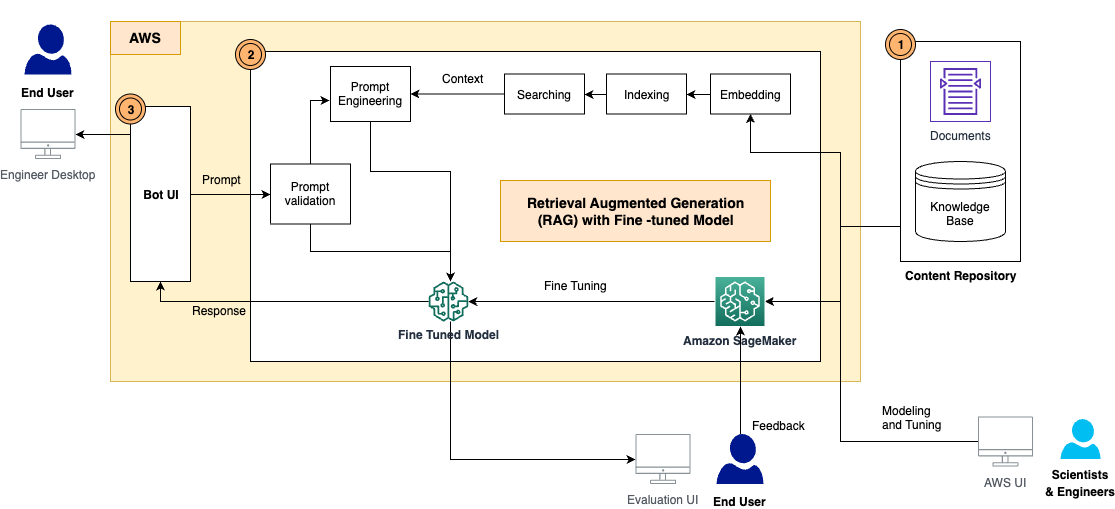
A tuned model may understand the desired response format or company language, while RAG supplies current information.
Example: insurance support
A fine-tuned model can learn how to classify an incoming claim and produce a structured summary. RAG retrieves the current policy language and coverage rules.
The system gets stable behavior without freezing current policy facts inside the model.
Use All Three Only When the Business Case Justifies It
It is possible to combine a fine-tuned model, RAG, and agent orchestration. That does not mean you should start there.
Every layer adds cost and failure modes.
A sensible progression
Start with prompting. Add RAG if current knowledge is needed. Add fine-tuning if behavior remains inconsistent at scale. Add agent actions if the business process needs tools.
Stop when the system solves the problem.
Compare Cost by Successful Outcome
Each pattern creates different cost drivers.
RAG costs
Embedding, indexing, vector storage, retrieval, reranking, model context, and document maintenance.
Fine-tuning costs
Training runs, training data preparation, model hosting or inference, evaluation, retraining, and model version management.
Agent costs
Multiple model calls, tool calls, retries, state storage, tracing, orchestration, and human review.
Measure cost per useful result. A more expensive architecture can be worthwhile if it replaces a larger amount of manual work.
Consider Latency
RAG adds retrieval steps. Agents may add several model and tool calls. Fine-tuning may reduce prompt size and sometimes improve task efficiency.
Match the design to the user experience.
Interactive applications
Users notice delays. Keep retrieval focused, use parallel calls where safe, and avoid unnecessary planning loops.
Background workflows
A task that runs overnight can use more steps if it produces a better outcome. Optimize for cost and reliability rather than instant response.
Consider Maintenance
RAG requires document and index maintenance. Fine-tuning requires dataset and model lifecycle management. Agents require tool, permission, workflow, and policy maintenance.
The most sophisticated architecture is not always the easiest to keep correct six months later.
Ask who will own it
Name an owner for knowledge sources, training data, model evaluation, integrations, agent policy, and incident response.
If no team can maintain a component, remove it from the design.
Consider Security and Privacy
RAG risks
Unauthorized retrieval, poisoned documents, outdated sources, sensitive embeddings, and prompt injection from retrieved content.
Fine-tuning risks
Sensitive training data, memorization concerns, poor data provenance, model leakage, and difficult deletion workflows.
Agent risks
Over-permissioned tools, unsafe actions, credential misuse, prompt injection, uncontrolled external calls, and autonomous error chains.
Use the least complex pattern that meets the requirement because every additional component expands the security surface.
Example 1: Employee HR Assistant
The goal is to answer questions about leave, benefits, expenses, and internal policies.
Best starting point: RAG.
Policies change, so the system should retrieve current approved documents. Add user permissions if some policies are role- or country-specific.
Fine-tuning is not necessary unless the organization has a strong need for specialized formatting or classification. An agent is not necessary unless the assistant needs to take actions such as submitting a request.
Example 2: Support Ticket Classification
The goal is to classify millions of tickets into stable categories with high speed and low cost.
Best starting point: prompt a small model and measure it. If quality or cost is insufficient, consider fine-tuning.
RAG may not help because the task depends on stable labels, not changing knowledge. An agent would add unnecessary complexity.
Example 3: Sales Account Preparation
The goal is to prepare a meeting brief using CRM records, email history, recent company news, and product usage data.
Best starting point: RAG plus an agent.
The system needs current information from several sources and must coordinate several retrieval steps. Keep write access disabled if the only output is a brief.
Example 4: Automated Customer Renewal Workflow
The goal is to identify customers approaching renewal, summarize account health, draft outreach, update CRM tasks, and notify the account owner.
Best starting point: agent plus retrieval.
Use structured tools for CRM actions. Require approval before sending external messages until the workflow has been thoroughly tested.
Fine-tuning may help later if the company has thousands of approved outreach examples and needs very consistent output.
Example 5: Contract Clause Extraction
The goal is to extract party names, renewal dates, liability caps, governing law, and other fields into a strict schema.
Best starting point: prompting with structured output. Consider fine-tuning if the volume is high and the base model repeatedly misses the same patterns.
RAG may be useful for interpreting clauses against current policy, but it is not required for basic extraction.
Create a Decision Scorecard
Score each proposed architecture from one to five in these areas:
- Accuracy
- Freshness of information
- Action capability
- Security risk
- Latency
- Cost
- Implementation effort
- Maintenance effort
- Explainability
- Evaluation complexity
Weight the areas based on the business. A legal assistant may prioritize accuracy and citations. A high-volume classifier may prioritize cost and speed.
Build an Evaluation Set Before Architecture Experiments
Without a fixed test set, teams often choose the architecture that looks best in a demo.
Collect representative real tasks. Include easy, difficult, incomplete, ambiguous, and risky cases. Define the correct outcome.
Evaluate each component separately
For RAG, measure retrieval relevance and answer grounding. For fine-tuning, measure behavior improvement on unseen examples. For agents, measure tool selection, action accuracy, policy compliance, and safe escalation.
Use Observability From the Beginning
Modern enterprise AI systems need traces, not only chat logs.
AWS’s 2026 guidance on agentic retrieval emphasizes observability across retrieval and agent workflows. This matters because a wrong final answer may start with a bad query, weak retrieval, tool failure, or incorrect routing.
Record useful events
- Prompt version
- Model version
- Retrieved sources
- Retrieval scores
- Tool calls
- Latency by step
- Token usage
- Retries
- Policy checks
- Final business outcome
Run a 45-Day Architecture Pilot
Days 1–10: Baseline
Define the business task and create the evaluation set. Test a strong base model with prompting only.
Days 11–20: Add the smallest missing capability
If knowledge freshness is the gap, add RAG. If consistent behavior is the gap, test fine-tuning. If actions are required, add a read-only agent workflow.
Days 21–30: Compare results
Measure quality, latency, cost, security complexity, and maintenance requirements.
Days 31–40: Test edge cases
Use outdated documents, malicious content, unavailable tools, unusual formats, and requests outside normal scope.
Days 41–45: Make the production decision
Choose the simplest architecture that meets the target. Document why more complex options were rejected.
Common Architecture Mistakes
Fine-tuning for facts that change. Use retrieval for current information.
Using an agent when a single model call works. Extra orchestration adds cost and failure points.
Building RAG on dirty documents. Knowledge quality matters.
Fine-tuning without an evaluation set. You cannot prove improvement.
Giving agents broad tool access. Use least privilege.
Combining all three patterns immediately. Add complexity only when a measured gap requires it.
Ignoring operations. Production AI needs monitoring, ownership, and change control.
Final Decision Checklist
- Business problem defined in one sentence
- Success metrics agreed
- Current/private knowledge requirement identified
- Stable behavior requirement identified
- Action requirement identified
- Prompt-only baseline tested
- Evaluation set created
- Data permissions mapped
- Security risks reviewed
- Cost per successful task estimated
- Latency requirement defined
- Maintenance owner assigned
- Observability planned
- Least-complex viable design selected
Conclusion
RAG, fine-tuning, and AI agents are not competing answers to the same question. They are different tools.
Use RAG when the model needs current or private knowledge. Use fine-tuning when you need stable behavior learned from examples. Use agents when the system needs to coordinate steps and take actions through tools.
Combine them only when the business problem requires the combination. Start with a strong prompt and an evaluation set. Add the smallest missing capability. Measure quality, security, cost, latency, and maintenance together.
The best enterprise AI architecture is rarely the most complicated one. It is the simplest design that can deliver the required outcome reliably and safely.
Official Resources
For current technical examples, review AWS guidance on observable enterprise agentic retrieval, Amazon Nova fine-tuning guidance, and AWS guidance on advanced fine-tuning and multi-agent orchestration. Confirm current service capabilities and pricing before selecting a production architecture.
Leave a Reply