AI Research Assistants in 2026: How to Verify Sources and Avoid Fake Citations
An AI research assistant can speed up topic discovery and make notes easier to sort. It cannot replace checking evidence. This guide gives students, writers and business teams a practical path from a model’s suggestion to a claim they can trust.
Check a source in two moves
An AI tool may give you a study title and a strong claim. First, find the real paper or report. Check the author, date and title. Then open the part that holds the claim. A real paper can still be the wrong source for your sentence. If you cannot find the proof, remove the claim. Readers gain more from one sound fact than five weak ones.
Use AI for leads, not proof
What can go wrong
An AI research assistant can suggest terms, sources and questions to investigate. It can also produce confident text that has no matching source. Treat the first answer as a map of claims to check, not as a report you can cite.
A better workflow
For a market brief, ask the assistant for five questions that would change a decision. Then search for original data that answers those questions. This separates planning from verification and reduces the urge to accept a neat but weak summary.
Write a narrow research question
What can go wrong
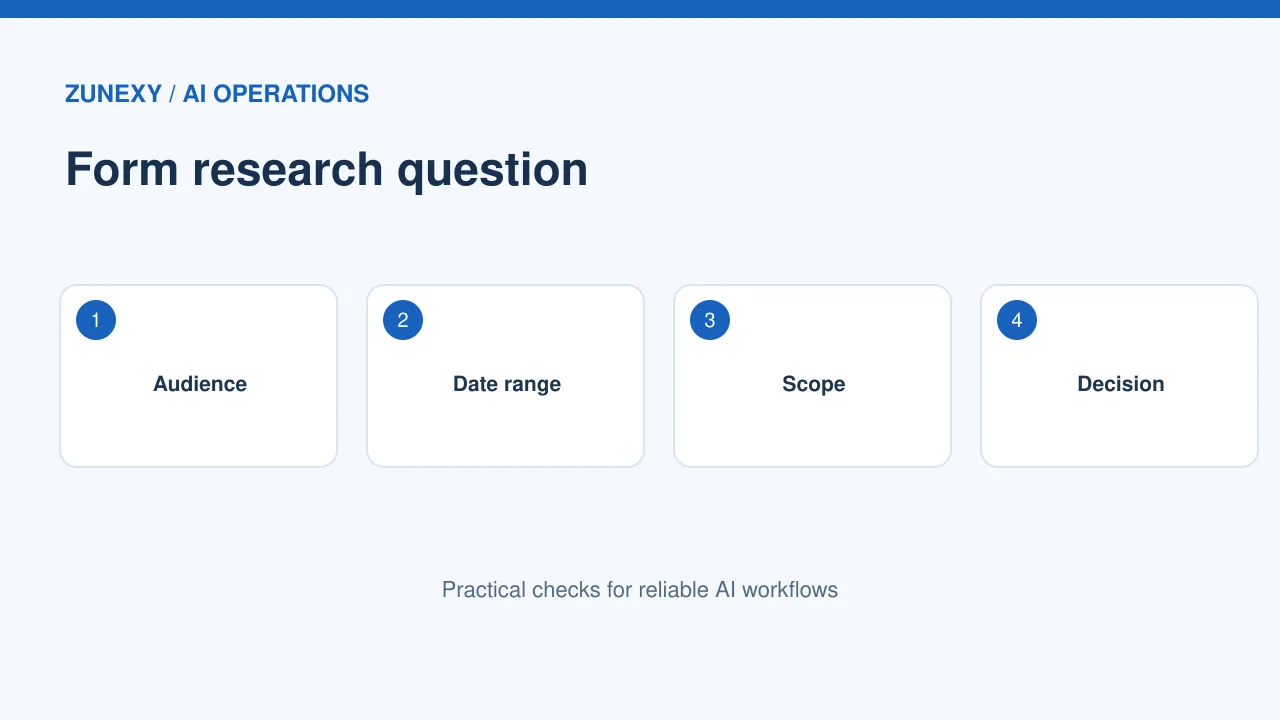
Broad prompts invite broad answers. Set the topic, date range, region, audience and decision. Ask the tool to mark uncertainty. A useful question might ask which factors affect cloud migration costs for small firms, rather than whether cloud is good.
A better workflow
Create a claim table with the proposed answer, source, date and confidence. Leave the source cell blank until you open a document. A model’s self-rated confidence is not evidence. But a clear list of claims gives a human a checkable task.
Search beyond one tool
What can go wrong
Use library catalogs, public agencies, research databases and an organization’s own records. Search by exact report name and author. Check the publishing organization before trusting a web snippet. Avoid copying a summary of a summary when primary data is available.
A better workflow
If an answer mentions a government survey, open the agency’s actual release. Find the table and definitions. It may measure firms in one country, not the whole world. Record that limit. A valid statistic can still mislead when it is used for the wrong group.
Verify every citation
What can go wrong
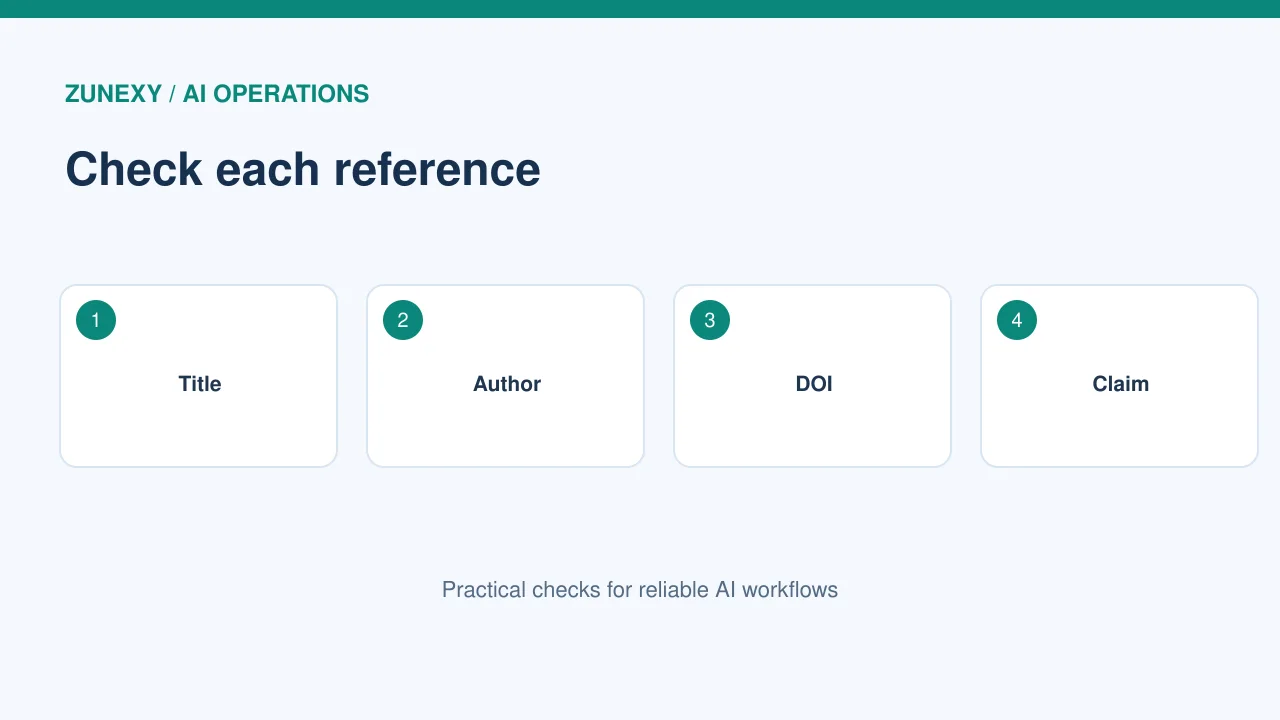
A citation can look perfect and still be wrong. Check the title, author, venue, date and identifier. Open the paper or publisher page. Confirm the claim appears there. If the work cannot be found, remove it rather than guessing a replacement.
A better workflow
For academic items, [Crossref](https://www.production.crossref.org/documentation/retrieve-metadata/rest-api/) offers searchable DOI metadata. Matching metadata helps confirm a record exists. But it does not prove the paper supports your sentence. Read the abstract, method and relevant passage.
Distinguish kinds of evidence
What can go wrong
A peer-reviewed study, a vendor blog and a user comment can each be useful for different questions. Do not give them equal weight. A vendor may know its own product details but also has a sales interest. A user review may reveal friction but not represent all customers.
A better workflow
Write the source type beside each claim. Use an official product page for a feature or price that may change. Use original studies for measured outcomes. Use direct interviews only when you have done them and can describe the method. Do not invent first-hand tests.
Check dates and versions
What can go wrong
Research about fast-moving tools can age quickly. Note when a source was published and when a product feature was last checked. A current article can cite an older framework if it is still relevant. But it should not describe an old plan as today’s price.
A better workflow
If an AI answer says a tool has a free tier, open the vendor’s current plan page. If it quotes a benchmark, look for model version, hardware, data set and test date. Write those conditions so readers can judge whether the result applies.
Follow the number to its origin
What can go wrong
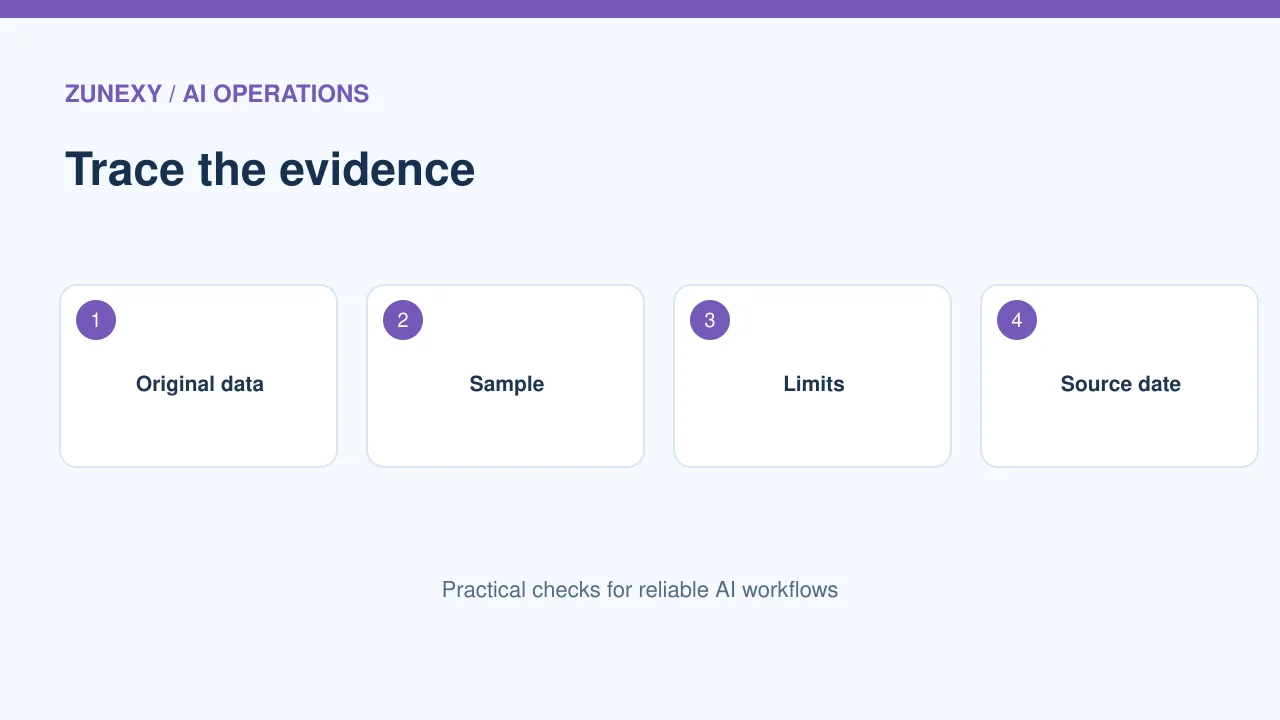
Statistics often travel through many articles. Find the first organization that collected the data. Read what the percentage is of and how the group was chosen. Pay attention to sample size and whether the figure is a forecast or an observed result.
A better workflow
A statement like ‘most workers use AI’ is too vague. Does it refer to surveyed workers, all employees, paid tool users, or people in one industry? Replace the broad claim with the actual population or leave it out. Precision is a service to the reader.
Watch for mismatched quotes
What can go wrong
AI may paraphrase a person and wrap it in quotation marks. Search for the exact wording in the original talk, interview or text. If you cannot confirm it, write a clearly labeled paraphrase and cite the source, or do not include the quote.
A better workflow
A short paraphrase is often better than a dramatic line. Explain what the source actually argued and why it matters to your question. Do not add names to make a weak point look expert. Authority should clarify facts, not decorate them.
Build a useful comparison
What can go wrong
A decision memo needs criteria, not just product names. Choose the same tests for every option: fit, cost, data handling, support, limits and a real task. Score only criteria you can inspect. Mark unknowns instead of quietly giving them a middle score.
A better workflow
For three document tools, upload the same non-sensitive test file and ask the same questions. Check if each cites the right passage, keeps table values and handles an unanswered question. Record observed results and date. This is a practical first-hand test if you actually perform it.
Use a source review pass
What can go wrong
After drafting, highlight every factual claim that depends on outside evidence. Open its cited source and check whether wording matches. Look for missing limits, outdated figures and unsupported causal claims. Keep your own analysis separate from direct findings.
A better workflow
Ask a second reviewer to examine the three most important claims. A fresh reader may catch that a cited source discusses a different product or group. Revise the conclusion when evidence changes, even if the first draft sounded more exciting.
Protect research data
What can go wrong
Do not paste client records, private interviews or unpublished documents into an AI tool without approval. Check data retention and access settings. Use redacted text when a public prompt will do. Keep a source archive in a controlled place.
A better workflow
For a sensitive project, build a local note of titles, dates and verified passages. The AI tool can help organize public information while confidential conclusions remain in the approved system. Research speed is not worth a data leak.
Publish with an honest trail
What can go wrong
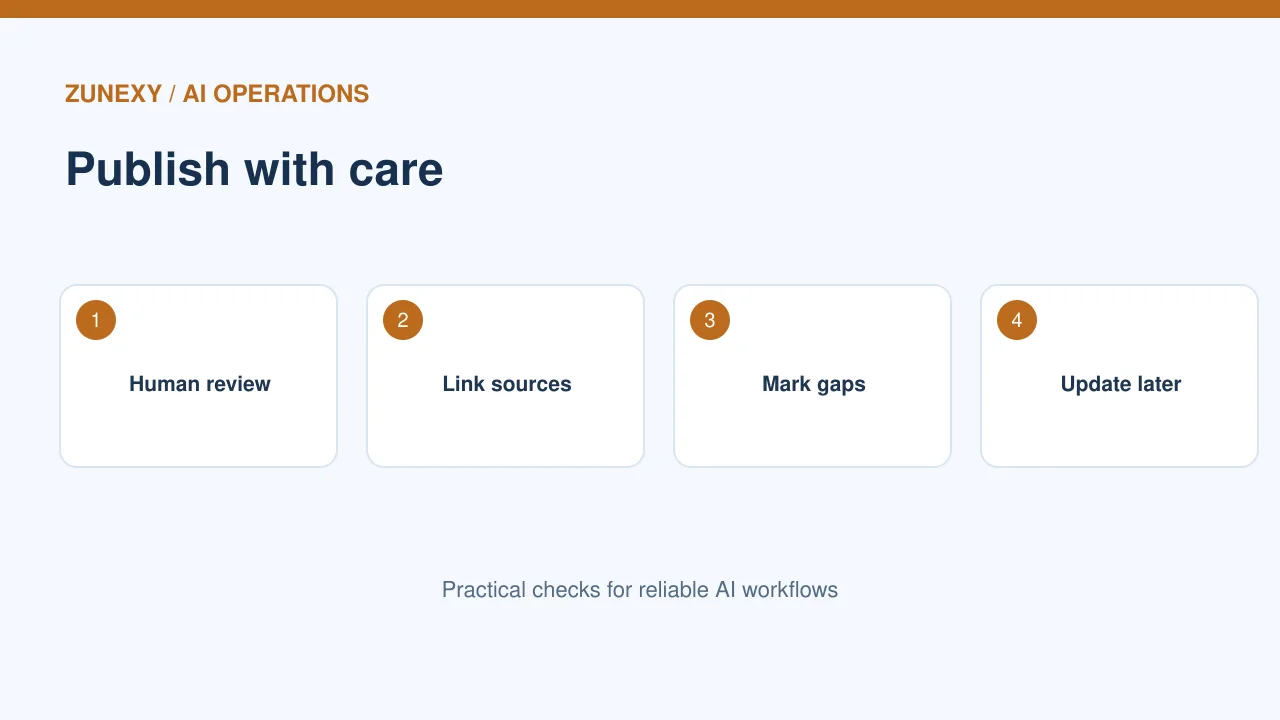
Readers should know where a claim came from and what remains uncertain. Link the organization or publication name naturally in the article. Give dates for fast-changing facts. Correct an error visibly when new evidence appears.
A better workflow
A strong research workflow ends with a short source list in your working notes, not a pile of links inserted without review. Save the checks so a teammate can refresh the article later. The goal is an answer someone else can verify.
Final fact-check list
- Open each cited source.
- Match title, author, date and claim.
- Trace key numbers to original data.
- Check product details against current pages.
- Mark tests you actually performed.
- Remove unverified quotes and references.
AI is most useful as a research partner when every important claim has a clear path back to evidence. Keep that path short, honest and easy to revisit.