How to Test an AI Workflow Before Launch: A Practical Evaluation Guide for 2026
A demo can make an AI workflow look ready in five minutes. Real work is less neat. A customer may ask a vague question. A document may be out of date. A tool may return no result. Before a business relies on an AI workflow, it needs to know what happens on an ordinary day and on a bad one. That is the purpose of an evaluation plan.
You do not need a research lab or a large test budget to begin. You need examples from your own work, a clear idea of a good answer, and a way to record failures. This guide shows how a small team can test an AI workflow without hiding errors behind a single average score.
Decide What Success Means in the Real Task
Start with one narrow workflow. Imagine a service team using AI to draft replies to requests about order status. A reply should use the right order, explain what the status means, and avoid making a promise that the company cannot keep. Those three outcomes matter more than whether the text sounds polished.
Write a short pass rule for each outcome. For order status, a pass could mean that the draft matches the status returned by the approved order system. For promises, it could mean that the draft never invents a delivery date. For tone, the answer should be easy to read, kind, and free of needless detail. Keep facts and style as separate checks so a friendly wrong answer still fails.
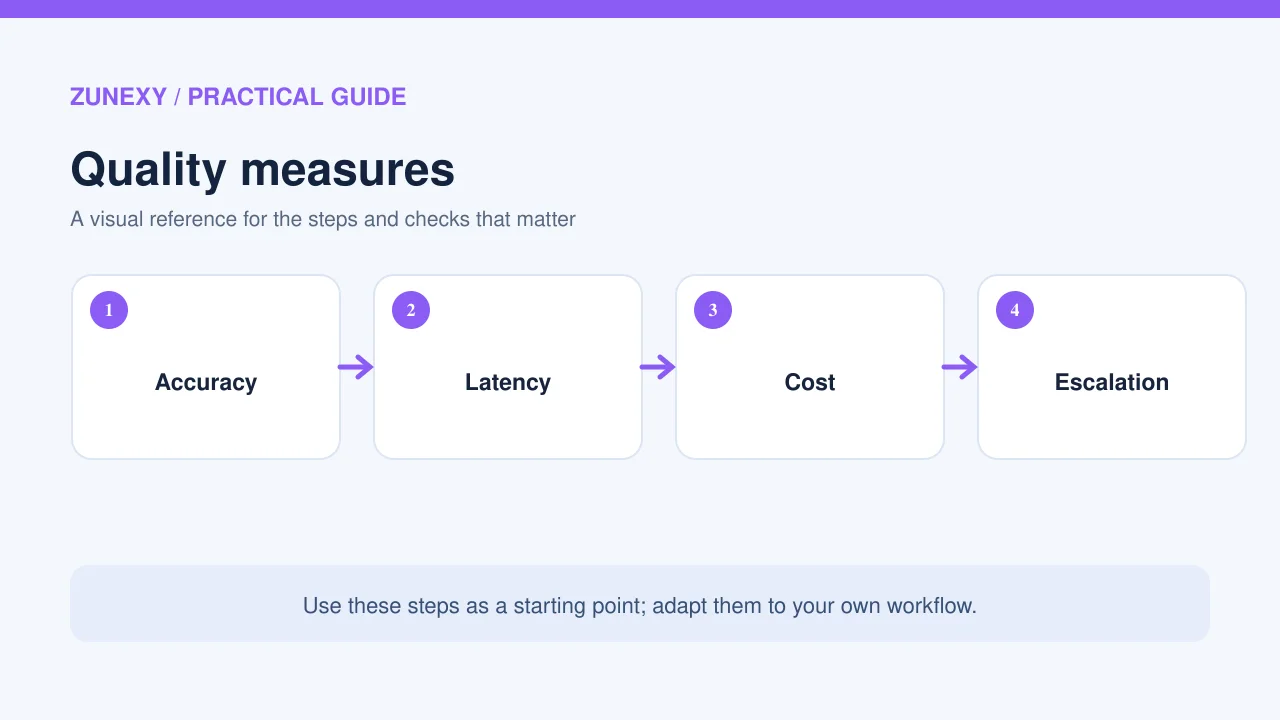
Choose what to measure first
Pick the errors that would hurt users or the company most. A false refund promise may be severe. A sentence that sounds stiff may be mild. Rate each case by impact as well as frequency. This keeps a batch of easy successes from hiding one unsafe result.
Build a Test Set From Real Work
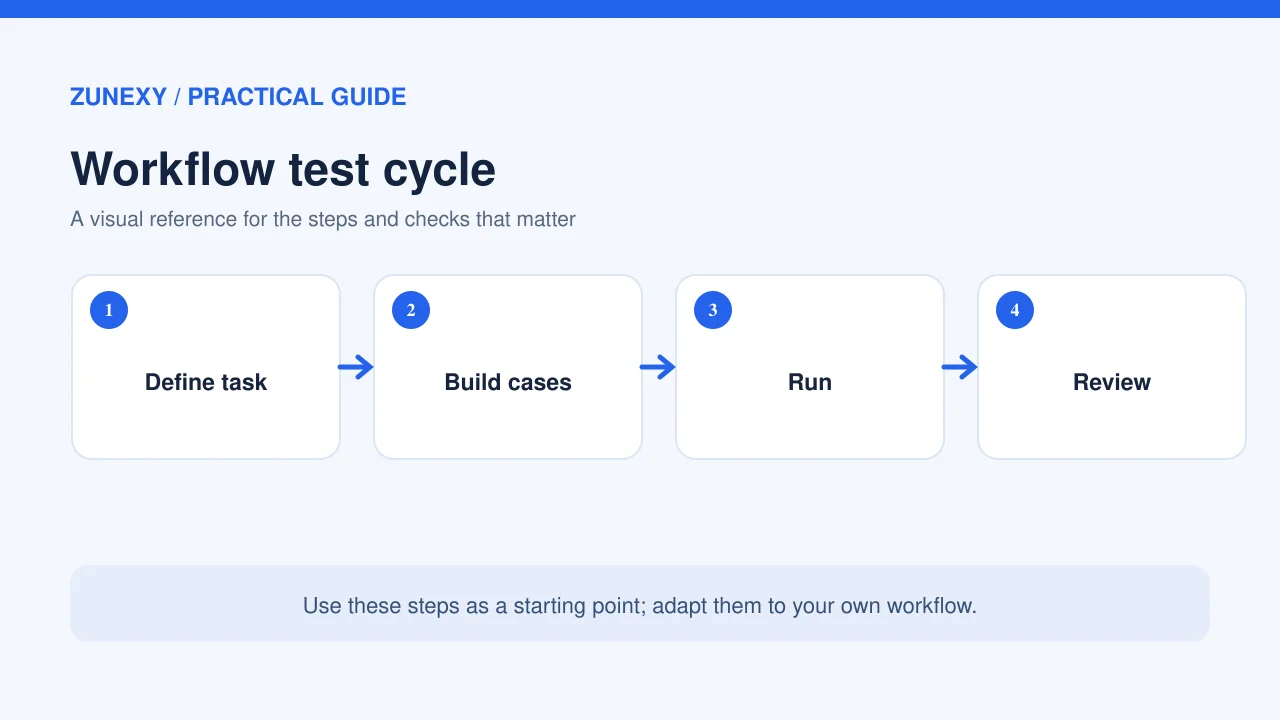
Take a small sample of past tasks, with private details removed. Include simple cases, unclear cases, and cases where the right response is to say there is not enough data. Ask staff who know the process to check that the sample reflects the questions users really ask. A test set drawn only from marketing examples will give false comfort.
A useful first set might contain 40 to 60 cases. That is a starting point for a small pilot, not a universal standard. It gives reviewers enough variety to see patterns while keeping manual checks manageable. Save the test prompts, source facts, expected rules, and review notes. Do not use real personal details if dummy data will serve the same purpose.
Include cases with missing information
If an order lookup fails, a good assistant should not fill in a likely answer. Test blank results, expired records, odd date formats, and requests for an order that belongs to someone else. These cases show how the app behaves at the edge of its data. They also help you set a clear path to a human agent.
Include language and region variety
A global service may receive short messages in different forms of English and in other languages. Test the ones your team serves. Ask a person who knows each language to judge key meaning. A model that handles a polished English sample may still miss the intent of a short message with local terms. Avoid using one score to speak for every region.
Separate Model Quality From Tool Quality
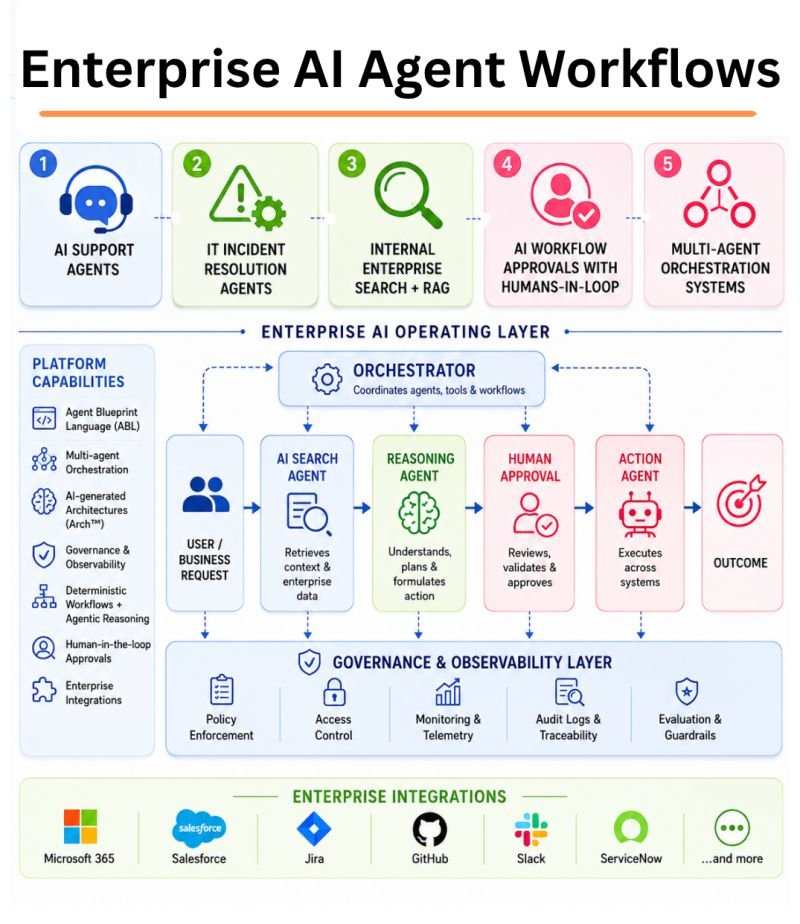
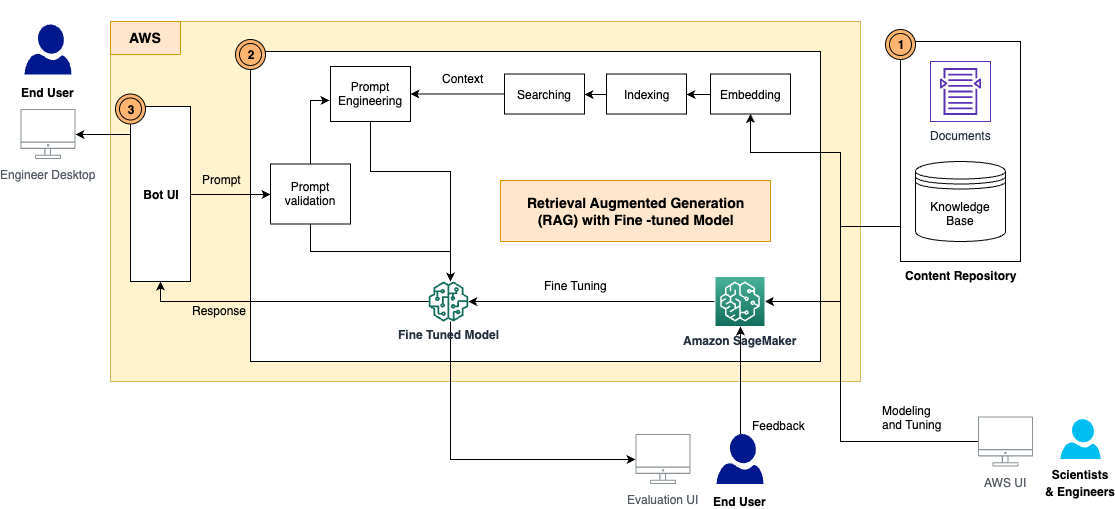
An AI workflow often combines a model, a search step, and one or more business tools. When the result is wrong, the cause may not be the model. It may be an old document, a bad search match, a timeout, or a missing permission. Log the source and tool result so reviewers can find the cause.
For a knowledge assistant, check that the answer uses the right source and that the source supports the claim. For an action agent, check the exact request it sends to a tool and whether the action was allowed. A correct sentence cannot make an unsafe file change acceptable. Give tool behavior its own pass rules.
Test the source trail
Ask a reviewer to trace each important fact to a document or a system record. If the source says returns take up to ten business days, the AI should not promise five. If two sources disagree, the workflow should use the approved source or flag the conflict. This catches errors that a general text similarity score may miss.
Set Up a Simple Review Sheet
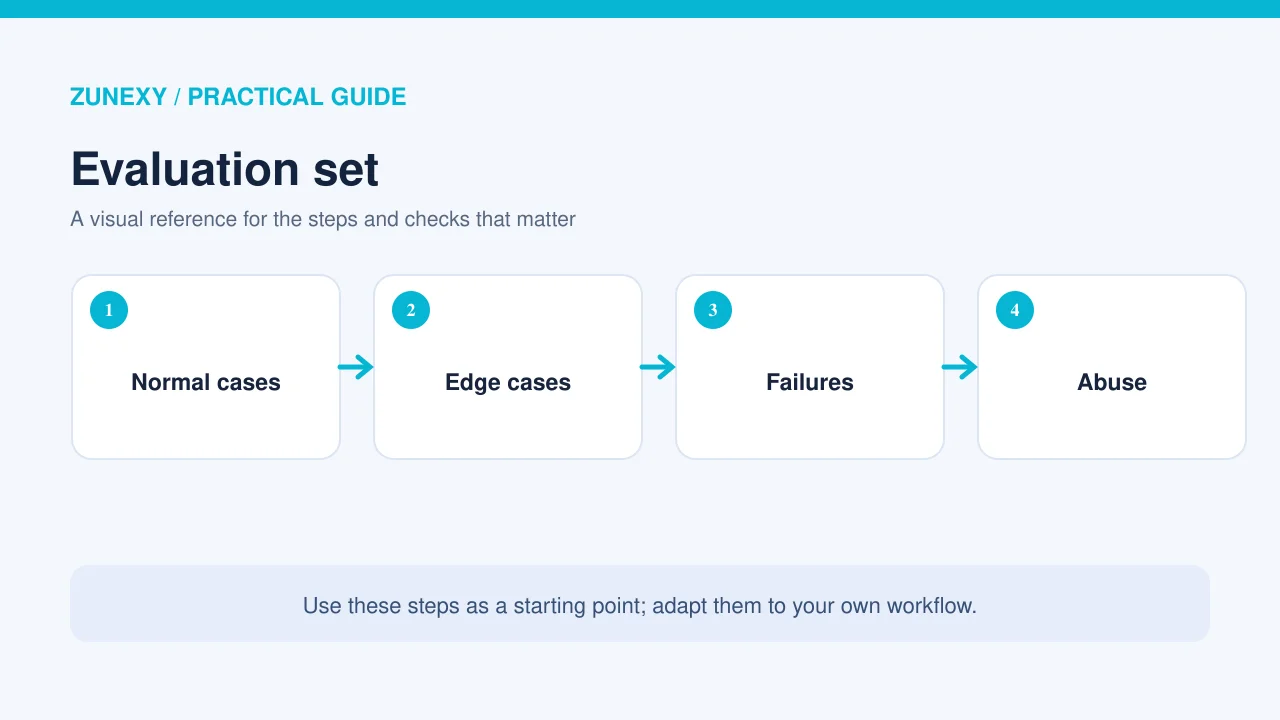
A small team can begin with a table. Give each case an ID, input, expected behavior, observed behavior, error type, severity, and reviewer note. Keep the raw answer and any tool call in a secure test record. Reviewers should be able to explain why a result passed. If the rule is unclear, refine it before scoring a large set.
For open questions, use a short rubric. A reviewer might award one point each for factual support, complete coverage, and safe handling of uncertainty. Keep critical safety checks as hard pass or fail rules. A score of two out of three should not excuse a private data leak.
Reduce reviewer disagreement
Ask two people to score a small group of examples independently. Compare results and discuss the cases that differ. Often the issue is the rubric, not the reviewers. Add one clear example of a pass and one of a fail for each rule. Repeat this check after the task changes.
Test Changes Against a Baseline
Do not judge a new model or prompt from a few fresh demos. Run the same test cases on the current version and the proposed version. Compare the important failure types and the number of correct results. Keep a separate small set of new cases to spot overfitting. If the new version improves style but causes more wrong tool calls, do not deploy it yet.
Record the model version, prompt version, tool settings, retrieval index date, and test date. AI services change over time. A result without those details can be hard to repeat. If a provider changes an endpoint or retires a testing feature, preserve your case set and rubric so you can move it to a new runner.
Try a Controlled Pilot With People
After offline tests, place the workflow in a limited live pilot. Keep humans in control of customer replies and high-impact actions. Start with volunteers who understand the process. Tell them what the assistant may do and what must be checked. Give them a quick way to flag mistakes without writing a long report.
Measure the time saved after corrections, not just the time to make a draft. If a person spends three minutes fixing an AI answer that took seconds to create, the total gain may be small. Count the share of cases sent to humans, too. A safe handoff can be a success even when the AI cannot complete a task.
Watch what users do, not only what they say
People may praise a tool in a survey and still stop using it. Look for steady use on the intended task, repeat corrections, and whether users trust the cited facts. Ask for a few detailed examples from staff. A single clear failure story often gives more insight than a broad satisfaction number.
The Numbers That Matter
The 2026 Stanford AI Index reports that organizational AI adoption rose to 88% among surveyed organizations in 2025, while use of AI agents was still at an early stage. That is a survey finding, not a claim about every firm on Earth. It shows why careful testing matters as teams try new tools faster than they build good controls.
The same research program notes gaps in responsible AI reporting. A high score on a broad benchmark does not show how a tool will handle a company’s private records and unusual cases. Your test set should reflect the setting where the workflow will run.
Use Evaluation Guidance Without Overcomplicating It
The NIST TEVV-Athlon framework discusses testing, evaluation, verification, and validation. For a small business, the useful lesson is to ask several questions: does the system do the right job, can you check its behavior, and does it still work in its intended setting? You can apply that idea with a simple case sheet and a safe pilot.
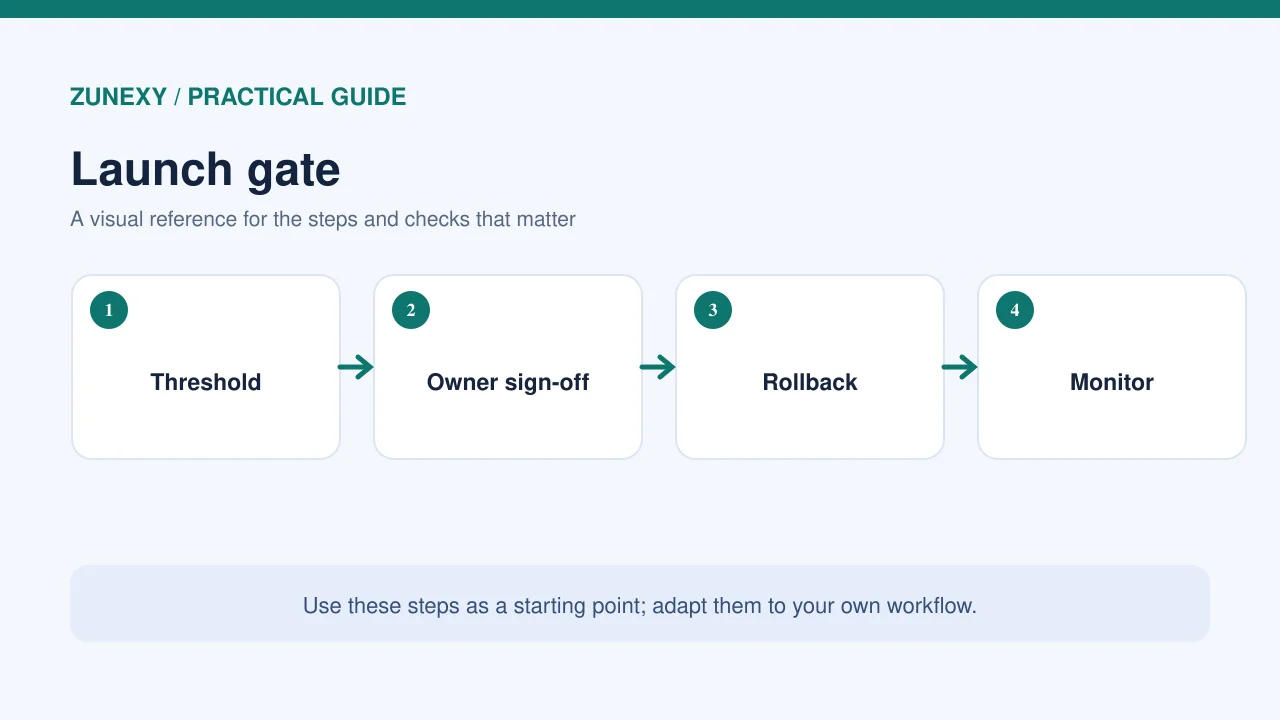
The ISO/IEC 42001 approach adds organizational responsibility. An AI workflow needs an owner, review steps, and a plan for improvement. You need not claim certification to use the principle. Set clear duties and keep a dated record of results.
Common Evaluation Mistakes
Using only happy-path examples
A set filled with easy questions will give a high score even when the system fails at missing data or mixed requests. Add real edge cases and revise the set as issues appear.
Asking the model to grade itself without checks
A model can help sort answers for review, but important factual and safety judgments still need a trusted reference or human expert. Check a sample of automated grades. If the grader and the app share the same blind spot, errors can look like passes.
Measuring speed and ignoring risk
A workflow may return an answer fast but leak data, use the wrong record, or mislead a customer. Set clear stop rules for those events. No speed gain is worth an uncontrolled write to a real system.
A Four-Week Plan
- Week 1: define one workflow, its owner, and clear pass rules
- Week 2: prepare 40–60 varied cases and calibrate reviewers
- Week 3: compare the baseline with the proposed workflow; fix severe failures
- Week 4: run a small human-approved pilot and review corrections
Keep the plan flexible. A complex or high-risk task may need far more testing. A simple internal draft helper may need less. The point is to make the evidence good enough for the decision. If results are poor, delay launch and fix the workflow. If the task cannot be made safe within the available controls, narrow what the agent is allowed to do.
Final Decision
Before launch, ask the team three questions. Does the workflow solve a real problem? Does it meet the pass rules on representative work? Can staff detect and contain mistakes? If all three answers are supported by test records, a limited rollout may make sense. Continue to sample live results and rerun tests after changes. The best evaluation plan is one your team will use again.
References
Stanford HAI 2026 AI Index, NIST AI evaluation framework, and ISO/IEC 42001 overview.